Unknown's avatar

About Andy Jervis

Welcome to my blog site. I've spent 30 years building a business - Chesterton House Group - designed to help people to achieve financial freedom, so that's my main interest and the core focus of my writings. True financial freedom isn't just about having enough money to do the things you want, it's about having a great relationship with money so that you can live in balance and get the most out of life. The best advice I ever had was to 'live each day as though it were your last, but plan as though you'll live forever.' I hope you enjoy the blog. Andy

Borrowing to Invest

Often the ideas in a blog post spring out of a conversation with a client or colleague, and this one is no different. So James, this one is for you.

Debt is expensive, and your lender needs to make a return on their money so they aren’t going to give you interest on cash you deposit with them of more than they’re taking off you in loan interest or they’ll soon be broke.

So why borrow at all?

Reason one is to enable you to buy something now and pay later. Your house is the obvious example.

The second reason is to invest. If you can make a return on the borrowed cash of more than the cost of the loan, you’re in profit.

The problem is that generating a return of more than your loan interest rate can only usually be done by accepting more risk. The scale of this risk will determine your willingness to borrow.

If the money is going in to your own business you might think the risk is worth taking. If you can borrow £x and turn it into £10x or £100x that sounds like good business.

You could put the money into shares or similar investments. The returns should be better, but there’s no guarantee, and the value of your borrowed investment can fluctuate wildly.

If you’re using mainstream investments borrowing to invest might still be an attractive strategy. The return on a well-managed mixed portfolio (shares, bonds, etc) has averaged several percent a year more than the average mortgage rate for decades, so profits should be forthcoming.

By far the most popular form of borrowing to invest is to purchase investment property. Whilst the returns aren’t spectacular, the income you’ll receive from renting out your house or building is reasonably predictable. You’ll be able to work out the return for yourself.

Investing in property has some other important features. Firstly, it’s easier to get someone to lend you the money in the first place. Lenders are happy to take property as security for your loan, and if you can’t keep up the repayments they could grab it back and sell it to get their money back.

Secondly, interest payments on property investments can usually be set against the rent for tax, reducing the true cost of borrowing significantly, especially if you pay tax at the higher rate.

The third reason is one of psychology. People view property investments as long term so they tend to worry less about swings in the price of houses or buildings. They will ride through economic downturns and tough times to get the benefit of long term growth.

There are very few lenders, on the other hand, who would accept your share and bond portfolio as security, so you’re restricted to either borrowing lesser amounts in the form of a personal loan, or using a property that you own as the security the bank will require. I’m not sure there’s a lot of sense in this rule, but that’s how it is.

Your share portfolio will probably require tougher nerves, too. The sheer visibility of share prices is a big reason why many people don’t stay the course. They are much more likely to cash in when times are bad instead of riding through the ups and downs to get the returns that come through over time.

So is it worth it? Let’s put some numbers on the table to show what’s possible.

Let’s say you borrow £100,000, in the form of a mortgage on your existing property, at a loan interest rate of 5% a year. Here are the figures:

At start 5years 10 years 15 years 20 years 25 years
Amount borrowed £100,000 £100,000 £100,000 £100,000 £100,000 £100,000
Total loan plus interest cost at 5% £100,000 £125,000 £150,000 £175,000 £200,000 £225,000
Total loan interest cost at 5% with 40% tax relief £100,000 £115,000 £130,000 £145,000 £160,000 £175,000
Amount invested at 3% compound growth £100,000 £115,927 £134,392 £155,797 £180,611 £209,378
Amount invested at 5% compound growth £100,000 £127,628 £162,889 £207,893 £265,330 £338,635
Amount invested at 7% compound growth £100,000 £140,255 £196,715 £275,903 £386,968 £542,743
Amount invested at 9% compound growth £100,000 £153,862 £236,736 £364,248 £560,441 £862,308

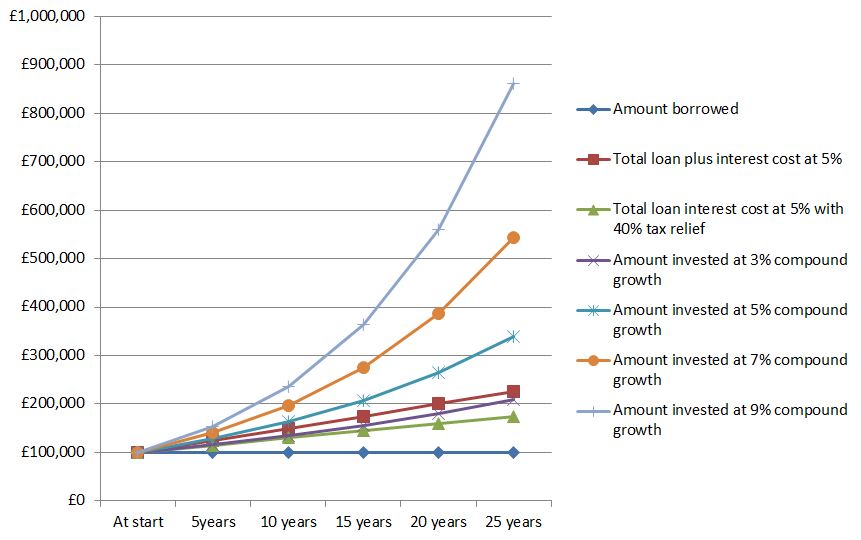
Or, to show it another way:

Chart

Interestingly, even where the loan interest and the return achieved are similar (as shown by the 5% less tax relief and 3% growth lines) the investment return still outstrips the loan interest cost over time. This is because of the compounding effect of the investment, whereby interest is earned on interest.

What this says is that if you could get a return of, say 7% a year whilst paying interest of 5%, over 25 years you would have made a profit of £317,743 in total, and if you could get a 9% return you’d be ahead by £637,308.

Of course it also shows that if your return is only 3% a year you’d be £15,622 worse off in total, although you would still have £109,378 left over if you paid off the outstanding loan at that point, because you’ve paid the loan interest along the way.

So should you follow this plan to get rich? As always, the answer is – it depends. There are a few questions you’ll need to ask yourself before you start. Here are some of them;

  1. Are you able to borrow the money in the first place? If the amount you want to raise is substantial you’ll probably need something to offer as security and you’ll need to show how you propose to make the repayments.
  2. Can you afford the repayments? Do you know how much they will be and how to calculate them?
  3. What will happen to your plan if the loan interest rate changes? Could you afford the extra commitment if the loan cost doubled, say? There was a period in the 1990’s when interest rates reached 15%. If that happened again, how would you cope? (everyone taking out a mortgage should consider this question, by the way).
  4. Do you know what the likely return on your investment will be?
  5. Do you understand how secure your invested capital will be? What’s the risk of losing some or all of it? Do you really understand what you’re getting into?
  6. Are you prepared for the inevitable swings in market prices and investment values? For example, an investment in shares would have returned around 9% a year over the last 20 years or so, but there were some years when values were down to almost half their previous level. Do you have the stomach for that kind of ride?
  7. Will you need to borrow for any other reason? If you’ve used up all of your credit line you’re going to have to sell something or do some tough negotiating to free up cash in the future.
  8. Are there restrictions or time penalties involved in either loan or investment terms? If your lender decides they want you to repay the loan immediately and you’ve put the cash into something that won’t pay out for five years you have what we call ‘a problem’.
  9. Is it worth it? Does the extra money you’ll make justify going through all of this work?
  10. Do you have the necessary skills to get the required returns for yourself? Or if you are giving the money to someone else to invest for you, have you carried out thorough (and I mean thorough) due diligence on them? Even the most plausible of people and finest of institutions can go pop or get their sums badly wrong, witness Lehman Brothers, RBS, Equitable Life, Tesco, etc., etc., etc.,…….). If in doubt pay for really good professional advice.
  11. If you’re dealing with an adviser; Do you understand the difference between sound advice and a sales story? Be especially careful of advisers who try to educate you. Here’s a quote from the Dalbar Report (dalbar.com); “Investor education….. has been used as the vehicle to transfer responsibility from the expert to the unwitting neophyte. By providing education, the investor is expected to make prudent decisions that relieve the expert of any responsibility. This use of education as a litigation defence may be effective in arbitration, in the courts and with regulators but it does nothing to protect the investor from making bad decisions.” I couldn’t have said it better myself.
  12. What does your partner or spouse make of your plan? Trust only goes so far. Full communication is better.
  13. What is there about your plan that is so obvious that you’ve overlooked it?

Having tried to scare you with what could go wrong, don’t forget that you don’t get to win the trophy by sitting in the changing room twiddling your thumbs. If you’ve answered these questions carefully you should be prepared and be able to avoid the worst mistakes. Having decided, stick with your plan! Persistence is one of the keys to successful investing.

Good luck!



Tickling the Ivories

My wife Sue, a capable keyboard player, sat down to teach me music. We decided that one lesson was enough. This wasn’t going to work.

For whatever reason I’m not in tune with music. I don’t often listen to music, I don’t buy music and I certainly can’t play music. Some might say that the ability is there in all of us, we just need to clear the mental blocks to unleash it, and that may be true.

But frankly, for me, it’s not worth the effort to find out.

I recognise that that’s how some people feel about money. It all seems too complicated, too much effort for the perceived benefit.

Most of us recognise that we’re never going to be a Mozart or a John Lennon. But there are countless people who have a lot of fun playing their instrument in their own way, and making a great sound that others can enjoy too.

If you want to be a player you’re going to have to learn the notes.


Two Types of Financial Freedom

There are two types of financial freedom.

Firstly, there is having enough money or passive income (pensions, royalties, dividends,) to not need to work.

But then there is the financial freedom that comes from knowing that you can work, whenever you want, for as long as you want, to meet your needs at this moment. It isn’t the same as having a job.

Typically the first requires years of effort, careful stewardship and ongoing maintenance.

The second works best if you travel light, and it’s available immediately.

Both can be rewarding.

But be careful trying to do both at once.


Mosel Mayhem

The country that invented the internal combustion engine is still very much in love with it.

Leaving our hotel window open to allow the ingress of cool air to make the night more comfortable also brings into the room the sounds of engines. Car after car, motorcycle after motorcycle, we hear those everywhere. But here, in this family hotel on the banks of the delightful Mosel river, there is more.

Tractors, for example, ripping past at no less velocity than the myriad Mercedes saloons. Or plying up and down the grassy riverbank, four-stroke powered cutting blades in constant action.

Then there is the great river itself, several hundred feet wide. Huge double barges, laden with coal and carrying a stylish living cabin at the rear together with two or three cars for the pilot and his family, power serenely by with a low thrum that can be heard long before the craft itself arrives. Regularly punctuating the peace is a speedboat or two, the driver indulging the German love of speed.

Not to mention the buses, lorries, pleasure boats, and assorted other petrol-powered paraphernalia that are part of the seeming conspiracy to break the natural silence of the mighty Mosel.

But there is peace to be found. Walking along the riverside towards the nearest town, Bernkastel-Kues, the path leaves the road far enough behind for the traffic noise to abate and the sounds of the trees, the birds and the movement of the water to once again return to prominence.

WP_20140908_007

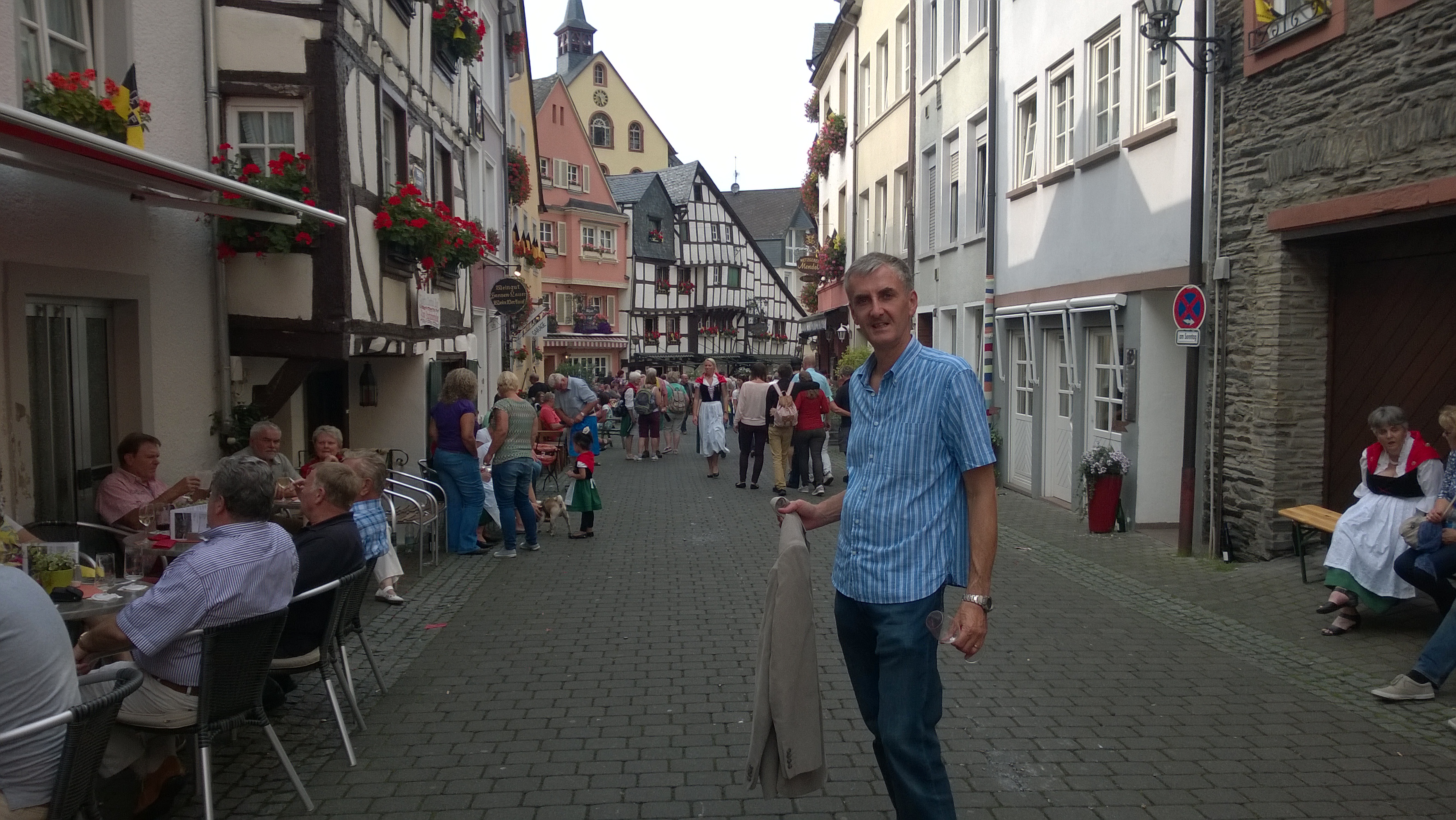
Until we reach the town itself, of course, and especially on this weekend in early September. It’s the time of the Weinfest of the Middle Mosel, an annual event that attracts thousands of visitors, all intent on enjoying the festivities.

The steep banks of the Mosel river, with their consequent good drainage and long exposure to the sun, make the production of the Riesling grape the dominant feature of the river, with a history going back to Roman times. The local area is dotted with small villages, each with its own vineyards and wine makers, many of them family concerns. Each year many villages have their own wine festival celebrating this year’s crop and presenting it for sale to the world, but they all come together in Bernkastel-Kues in early September for this major festival of the grape. The historic and colourful streets of the town throng with people who come to sample these wines, eat the local specialities and enjoy the party atmosphere among the many stalls, shops and restaurants. And whether you speak the local lingo or not, that atmosphere is infectious. It’s hard not to have a great time.

WP_20140907_008

The highlight of the weekend is the annual parade through the narrow streets and over the Mosel bridge, for which the traffic is halted and foot and wind power take over. Wind, that is, in the form of the many brass bands that are a mainstay of the procession. We stood for an hour and a half watching village after village, vineyard after vineyard and grower after grower make their way past. Many had their own highly decorated float, adorned by images of the grape, characters in period costume and, commonly, the local Wine Princess and her attendants looking down from on high. And all of them, or so it seemed, had its own band. Most were of the traditional brass variety, but both the instruments and the repertoire of tunes spanned the ages from Mozart to Michael Jackson, all seemingly accompanied by the beat of a very large drum.

Helping things along were the free samples. Each float was stocked with its own mini-cellar for offering to the crowd, and as the next wave approached arms were outstretched, replete with empty wine glasses, hoping for a top up. Success or failure in attracting the attentions of the ministering vintner were made loudly, all in good spirit and with great amusement. As you might imagine, the spirit and amusement increased as the afternoon – and the wine intake – wore on.

It wasn’t hard to imagine this same scene having been repeated countless times over centuries, and clearly there are traditions here that go back to the middle ages. A successful harvest and the first wines of the season would have been a major economic and social event for the region. They still are.

If you want to experience the best in German hospitality and to enjoy a great time in a delightful and picturesque area at an event that has spent hundreds of years refining how to have fun, come to the Weinfest. But book your hotel early or you probably won’t get in. And after a day sampling the wares of the good burghers of Bernkastel, you won’t want to be in charge of your own internal combustion engine as you wend your way home.

Standing In The Way Of Trade

I’m in Cologne, Germany, a city with a history from pre-Roman times. Like so many great cities, Cologne was built on trade, being ideally placed on the mighty Rhine and an important crossroads for different peoples over the centuries. It’s magnificent Cathedral is now one of the most popular attractions in Germany, with an average 20,000 visitors a day.

Cologne Cathedral

Despite losing almost 9 out of every 10 buildings in the Second World War, Cologne has reinvented itself as a new trade centre, with its easy access by plane, train and automobile making it a highly successful conference venue, it’s Koelnmesse centre hosting 2,000 conferences for 2.7 million visitors each year. It has also built a reputation as a  media town, with major TV networks and production facilities based here.

If you want to do business it certainly pays to stand in the path of trade. Open your shop where the people are, or where they can get to you easily. Even just being on the sunny side of the street can make a big difference.

Although opening your restaurant in the shadow of a Cathedral with this many visitors would still seem a wise business decision to me.

Controlling The Crazies

Recently I met with David Williams who has been instrumental in building Geldards into a leading East Midlands law firm.

Among numerous insights that David generously shared with me was his observation that you will employ people who are crazy and people who are sane. His job, he reflected, has been to make sure that every crazy person in his organisation was paired with a sane person.

Putting crazies with crazies is a recipe for chaos. But putting the sane with the equally sane means surefire stagnation.

I’m all in favour of giving my organisation a crazy edge, but I don’t think our business would work if we were completely bonkers.

Lamborghinis for Pensioners?

The Chancellor’s surprising Budget changes to the pensions regime obviously caught the opposition on the back foot. Given the complexity of current pensions legislation that’s probably understandable.
It was refreshing, though, to see some move away from the ever tightening grip of the state on the way we conduct our affairs towards a greater degree of freedom and choice. As a pension specialist, I certainly welcome this change which should make life easier for many and help rebuild some long lost faith in using pensions for retirement saving.


The idea of allowing people to choose how they use their own money was a radical one, but it hasn’t come before time. There’s a long history of government initiatives in the area of savings and investment that either didn’t work at all or resulted in unintended consequences. Indeed, the whole minefield of pensions legislation is an example of good ideas spoiled by excessive meddling.


So what has actually changed?

The new freedoms are not really new. We’ve had ‘Flexible Drawdown’ for a while now, which allows anyone with total guaranteed pension income of over £20,000 a year to take as much as they like from their accumulated funds. The Budget brought this figure down to £12,000 a year, meaning that someone with a full basic state pension plus at least £6,200 from a final salary scheme or annuity can now withdraw any amount they like from any additional ‘money purchase’ funds – such as a personal pension plan  – that they own.
As from next April, this lower minimum will be cast aside, and anyone over the minimum age for withdrawal, currently 55, will have full unfettered access to their funds at any time.


So what’s the catch, you may well ask? Why are the Government being so generous with your own money?


There’s a simple, one-word answer to this. Tax.
Any amount you draw out will be treated as taxable pension income in the year of withdrawal, so if you are already a taxpayer you’ll immediately lose 20% in tax. And if your other taxable income plus the withdrawal takes you into the higher tax band, that could become 40% or even 45% if you breach the top tax rate threshold.


Steve Webb, the Liberal Democrat Pensions Minister, was widely reported for commenting that anyone could use their pension fund “to buy a Lamborghini,” if that was their wont.


But queues at Lamborghini dealerships seem unlikely to appear. With a price of at least £135,000 for the cheapest model, an individual would need to withdraw at least £180,000 and probably much more to afford their dream car, even taking into account that a quarter of the fund could be taken tax free, in order to have enough left for the car after deduction of income tax. That’s why the Chancellor has forecast a bulge in tax receipts after the changes come into effect.


This kind of spending is likely to be well beyond the means of most pensioners. According to reports, the size of the average pension pot stands at around £25,000. However even this figure takes into account the significantly fewer but statistically important number with funds worth hundreds of thousands. One estimate suggests that a large segment of the population has less than £4,000 in their pension fund.


This low reliance on pensions could be to do with the law of unintended consequences I mentioned earlier. Successive governments have appeared hell-bent  on a witch-hunt against the entire pensions industry, with decades of negative publicity and oppressive legislation. Is it any wonder that the average man or woman is now completely antipathetic towards the whole subject?


Now more than ever people need good advice, if no longer about which annuity to buy (although that will remain the best option for a minority) then about how to make the most of their fund and pay least tax. For very many people, carefully investing and managing their withdrawals over time to match their tax and personal circumstances – something we at Chesterton House have been doing for our clients for years – will be easily their best option as a way to make their funds last into advanced age.


The Chancellor’s changes may just have ushered in a new era of personal responsibility for your own  retirement planning. If so, that would in my view be a Very Good Thing. What it does require, though, is a new breed of professional, independent advisers who can help people to negotiate this complex minefield with confidence. Frankly the personal financial advice industry hasn’t been in a fit state to deliver this before, but recent changes to the minimum qualifications required and the way in which advisers are remunerated are already having an impact and consumer confidence in advice should begin to rise.


With the future financial wellbeing of millions at stake, this is too important an issue to get wrong. Let’s hope that the Budget changes are just the first step into a brave new world of personal freedoms and the inevitable responsibilities that go with them.


Hire Great People, Then Get Out Of Their Way!

Sometimes the content for these blogs gestates over a period of time with various ideas coming together. Other times it just springs out of somewhere, often a conversation I’ve had with someone, and that was what happened today! So this blog is dedicated to you, David. I hope you find it useful.

We were talking about the problems of running a business and in particular finding really good people to be able to drive things forward for you. He had found a potentially really good candidate who could really take his business forward with lots of knowledge and industry expertise; but the asking price was too high. So what is reasonable to pay for a highly productive member of staff?

To help answer this question I turned to some of the people that I’ve found helpful in my quest over the years and the first one of those was Jim Collins. Jim has written a couple of books, one of which I found extremely helpful in formulating some of the philosophies in my business. It’s called ‘Good to Great,’ and it’s a classic. Some of the key ideas from the book are listed on Jim’s website at www.jimcollins.com . Let me take just one of those for you now.


It’s headed ‘Disciplined people – ‘Who’ before ‘What” and the way that Jim Collins describes it is to imagine yourself as a bus driver. The bus – your company – is at a standstill and it’s your job to get it going. You have to decide where you’re going, how you’re going to get there, and who’s going with you. Most people assume that great bus drivers (read: business leaders)immediately start the journey by announcing to the people on the bus where they’re going; by setting a new direction; or by setting out a fresh corporate vision. In fact the leaders of companies that go from ‘good to great’ start not with ‘where’ but with ‘who’. They start by getting the right people on the bus, the wrong people off the bus and the right people in the right seats; and they stick with that discipline –  first the people, then the direction – no matter how dire the circumstances.


Collins illustrates this principle by telling the story of the CEO of Fannie Mae, the big mortgage Corporation in the States, David Maxwell. Fannie Mae was losing $1 million every business day and the board wanted to know what he was going to do to rescue the company. Maxwell’s response was to say, you’re asking the wrong question. To decide where you want to drive the bus before you’ve got the right people on it, and the wrong people off it, is absolutely the wrong approach.


He told his management team that there would only be seats on the bus for ‘A-level’ people who were willing to put out ‘A-Plus’ effort. He interviewed all of his team and told them all the same thing; this is going to be a tough ride, it’s going to be demanding. If you don’t want to go along, that’s fine, just say. But now is the time to get off the bus. No questions asked, no recriminations.


When he put that to all of his executives, 14 out of 26 got off the bus. He replaced them with some of the best, smartest and hardest working executives that he could find, and with the right people on the bus in the right seats he then turned his attention to the ‘what’ question, and only then did he try to address that. By the end of his time with Fannie Mae, Maxwell had turned a performance of losing $1 million a day into earning $4 million a day at the end. Getting the right people on board was crucial to that success.


Here’s another article by Jim Walton, President of Brand Acceleration Incorporated in America. He describes how a great business friend of his was running a highly successful organisation with just two support people in his office. When asked how they managed that work load the boss had one simple answer; ‘These are the best people in the industry. I make it a point to hire great people, pay them very well, and then get out of their way.’


He gives the example of another boss with a similar style. On one particular day, he says, he had a management related question that he reluctantly took to the boss. After asking his question, the boss calmly walked across the room, closed his office door, and came back to his desk. Sitting down he said, ‘Jim we hired you because you’re very good at what you do. You’re paid very well and I’m pleased with your performance. However; if I have to handle management issues for youthen I don’t need you. Other than our regular P&L meetings and occasional chitchat at the coffee machine, we don’t really need to talk. Do we?’


That’s what it means to hire great people, pay them well, and then get out of their way. If you can find someone who can be creative, productive, intelligent, efficient – and those people are out there – how much are you prepared to pay them? That’s the question I would ask. Because when you find someone like that you really don’t want to stint.


So really there are two questions here. Firstly how deep are your pockets; but secondly -and this is actually much the bigger question – are you the sort of person that can pay them well and thenget out of their way? That takes a lot of confidence, a lot of trust, a lot of discipline, but in my experience it’s the way to riches.