Canal Trip: 3 – Manchester to Marple

The last two days have seen us navigate through two of the most dramatic lengths of waterway on our canal system, although dramatic for very different reasons. From the historic Castlefield Basin in the centre of Manchester we follow the first nine locks of the Rochdale Canal for our first drama.

20170629_104005

The canal rises up through the heart of the City to Piccadilly Junction, completely overshadowed by, yet an integral part of, huge office buildings, alongside people at workstations, gazing into their PCs and canalside commuters, business people and tradesmen, some of whom stop to watch us go by, some with a sombre blank expression, lost in thought, others with a cheery wave from an office window.


We go past and then right underneath huge buildings, the foundations of which form dark, low-roofed tunnels, Victorian history below a high-tech City. New construction soars over the canal, a working crane vertically above us as contractors create a new development straddling the canal. We have to duck low as the bridges press down on the waterway, stealing its valuable city space in every direction.


Trains and vehicles criss-cross the canal on historic iron and period brick arched bridges straight from the history books, mixed in with modern concrete, glass and steel structures that showcase the vibrancy above. It’s a hugely busy scene and one that has to be experienced to be fully appreciated.


As we approach Piccadilly we follow Canal Street, self-proclaimed home of Manchester’s Gay Village. Many of the bars along this colourful street overlook the canal, and travelling along here on a Saturday night must be a different experience again. Perhaps one we’ll forgo for now.


We’ve heard stories of problems with drug users in this area, and we keep our wits about us. Canals seem to draw certain types of people for some reason, and today there are a couple of young men who we aren’t too sure about. They seem harmless enough though, and we pass without incident.


At Piccadilly Junction we turn right on to the Ashton Canal and the 18 locks that take us up to Dukinfield. This part of the city has changed a bit since our last trip through here, with the Manchester City FC ground dominating the skyline and lots of new community developments. The locks, by contrast, are old, heavy and creaky. They have anti-vandal locks fitted which makes progress even slower, and this isn’t the most enjoyable flight we’ve ever navigated.


Coming through Manchester by boat isn’t an experience everyone would savour for their holiday, I’m sure. For me though, the trip has been hugely enjoyable and full of unusual perspectives on this great City. If you like life in all its aspects, you’ll enjoy it too.


And then, a day later, the total contrast of working the flight of 16 locks rising into Marple. The canal crosses a superb aqueduct, built in 1805, offering the always unusual experience of navigating a boat along a channel itself high above a waterway. The views down to the River Goyt below are vertiginous and stunning, a picture of the English countryside at its best. The locks themselves are as fine as any, set in gorgeous woodland with tantalising views through to the rolling countryside beyond. The solid stone locks are attractive and relatively easy to work after the slow and heavy Manchester versions, and Marple welcomes the canal to its heart with obvious pride.  Reaching the top feels like a real achievement, and we finish the day with a very tasty Indian meal on board, supplied by ‘Marple Spice’ only yards from the canal and highly recommended.


It’s been a very enjoyable day.

Canal Trip: 2 – Straight Through Sale

There’s a stretch of canal on the approach to Manchester that is unusual in boaters’ experience by virtue of its remarkable straightness. After miles of waterways that meander gently around bridges, trees, bushes and moored boats, swinging from left to right and back again following the contours of the land, this length is arrow-straight for over 2 miles – too far to see from one end to the other, so that the pilot can’t discern whether that shape in the far distance is an approaching craft or a bridge across the cut.


Slicing its way through Sale towards Stretford, this is one of the earliest waterways of its kind anywhere in the world. When built, it would have been a scar through open countryside, but its arrival in the late 1700’s – a gamble by Francis Egerton, Duke of Bridgwater after whom the canal is named, that nearly bankrupted him, costing a then colossal £200,000 – soon started to pay off as Manchester and its burgeoning industry started a revolution that was to lead the world. The price of coal from the Duke’s mines halved in price immediately, turning the demand into a clamour and leading to annual profits of £70,000, a good return on capital by any standards. This blossoming of enterprise led to a huge influx of workers, and they had to be housed somewhere. Ironically it was years later when the railways took over from canals that Sale became one of the world’s first ‘railway dormitory’ towns as thousands of commuters travelled in to the City to work.

20170628_145556

To Infinity….and Beyond!

Sale has matured since then, and the canal is no longer a scar but a sanctuary through the urban sprawl. Travelling this stretch is a delight, joined as we are by exercising joggers, serious runners, leisure cyclists and head-down commuters, to say nothing of the local dog population, all enjoying the wide and well-formed towpath on the west bank. On the east side the regular Manchester Metrolink trams are ever-present, reminding us of the proximity to the City.


Entering this straight one wouldn’t be aware of the built-up nature of the surrounding area if it were not for our map revealing all. We pass open fields and meadows, which give way to a nature reserve which doubles as a flood overflow area. Onwards we go, to a delightfully laid out park, a sports centre, rowing club and then a large cemetery, smart headstones laid out in neat rows with the vivid colours of remembrance flowers making a lovely picture despite the sombre purpose.


Further still and rows of well-kept cottages just a stone’s throw across the road are in keeping with the period feel of the canal, until we reach a school, a mix of old and new build with classroom areas on outside balconies so that, presumably, lessons can be held overlooking the canal. The King’s Ransom offers us its culinary and alcoholic delights from a deck running alongside the canal, no doubt to become much livelier later in the day. Further still to attractive modern flats, each with its own balcony, although none are occupied on this wet and windy afternoon. Everyone wants to be a part of this waterway.


From our vantage point on the slightly elevated rear of our narrowboat we have a view of all of this life in action. It is tempting to stop the boat, walk all the way back to the beginning, and explore each of these delights in turn, finding out more about them and savouring their story. I’m sure that this two-mile stretch of canal could yield more than enough material for several documentaries. It would be great to go exploring and find out more. One of the great pleasures of travel is the opportunity to experience such landscapes, and one of the great tragedies that one so often does so as an observer rather than as a participant.


And now here we are at Castlefield Basin, deep in the heart of Manchester. It’s a fascinating place, and an important part of our industrial and social history with its own story to tell. This trip is yielding some wonderful nuggets.

Canal Trip: 1 – Rainy City Delights

The rain is pattering down outside, and judging by the look of the skies it seems there is more water above us than below, even though we’re already afloat. One of the joys of holidaying in the UK is the unpredictability of the weather, which brings another unknown dimension to the experience we’re having.

If we’re going to tackle the inclement weather head-on there’s probably no better way to do it than from the helm of our narrowboat. We’re not far from Lymm on the approach to Manchester, in a surprisingly rural spot in our green and lovely countryside. The city beckons ahead.

As always on our canal system, surprises are a regular occurrence. If you have any interest in our industrial heritage, or even if you don’t, you can’t fail to be impressed by the engineering skills that helped to create the system in the first place. From our 21st century perspective the canals are a quaint anachronism of a bygone age, green corridors through a verdant land. At their inception, though, they were a bold and highly innovative solution to moving goods and produce around the country in bulk and at speed. When Josiah Wedgewood first starting shipping his valuable pottery, the only way was by pack horse. If you think canals are slow, try taking one of those from Stoke to London laden with china.

Rainy City Delights

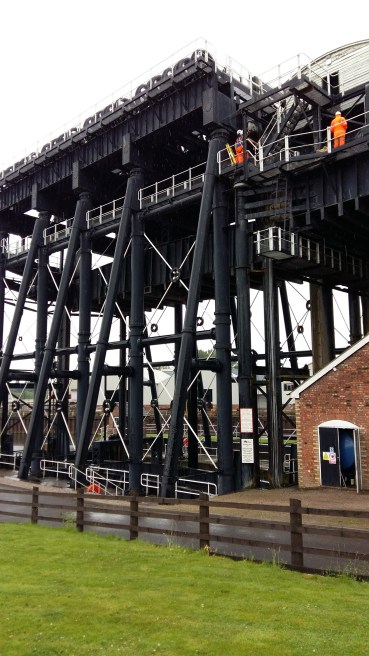
This innovation resulted in wonders such as the mile and three-quarter long Harecastle Tunnel which we tackled on Sunday, and the amazing Anderton Lift yesterday (Tuesday). Although strictly we didn’t ‘tackle’ Anderton so much as visit it, a special licence being required to navigate the River Weaver to which the Lift transports boats and their cargo from the Trent & Mersey canal above.

Like so many features of the waterways, when it was first built in 1875 people came from miles around to see the Anderton Lift in operation. After falling into neglect it was brought back to its former glory as a result of a preservation campaign in the 1980’s, and now the site hosts a lively and instructive visitor centre which offers an excellent fried breakfast along with boat trips between the two levels on their resident narrow boats. If you’re in this part of the world an excursion here is highly recommended. Make time to do the trip and you’ll have a very enjoyable and informative day out. You can find out all about it on the Canal & River Trust Website here.

Sunday evening offered one of those magical Summer evenings that are special to England, with no wind, a balmy temperature and the sun casting deep pink and golden hues across the sky. Chugging along gently on not much more than tickover, watching the world go by and feeling connected with it all, was about as good an experience as there is.

So if we have to put up with a few drops of rain today, so be it. At least Manchester is living up to its ‘Rainy City’ moniker. Who knows what further delights are in store?

Malcolm Swan – a Tribute to a Maths Genius

When I first met Malcolm Swan it was immediately apparent that the illness that was to take him already had a firm hold. Indeed, it was because of that illness and his prognosis that Malcolm had been referred to me in the first place.

I met with him and his wife, MargMalcolm Swanaret, several times as we worked together to get his affairs in order, but as is sadly often the case I felt that I got to know him best only after he had gone, and I came to attend his funeral service. What a moving occasion it was.
I knew that Malcolm was accomplished in his field, but I hadn’t appreciated quite how widespread his influence had been. He was a towering figure in the teaching of mathematics, and was obviously revered by his colleagues and peers for his work. He was one of those rare individuals who see the world differently, who delight in making the complex seem easy. Malcolm created a series of teaching aids and methods that changed both the way in which students received instruction and, much more importantly, the way in which teachers viewed their role. He was clearly a huge inspiration to literally millions of people – the online toolkit that he helped to create has been downloaded over 7 million times and is in daily use throughout the world. The tributes to him are packed with personal testimonies of the influence of Malcolm’s ideas.

The reason why Malcolm’s funeral was packed with mourners wasn’t just about his academic achievements, though – in fact I would suggest that they fell into a distant second place behind the fact that he was just such a loveable, generous and life-loving man. We heard about his playfulness, sense of humour and generosity, and mostly about his love of people. Malcolm was a committed member of his local church, and he loved working with young people, creating new ways to see the world and sharing his faith and positive view of life.

What a vivid contrast with the news from the previous day, when a young man in Manchester decided, for reasons we will never understand, to remove not only himself from this world but also as many other people as he could manage to take with him. No wonder that we were all so aghast at the terrifying thought of anyone packing nuts, bolts and shrapnel into an explosive package and detonating it inside a crowded hall of young people. Malcolm would have been distraught.

We will never be able to stop truly determined people from committing atrocities such as the one at Manchester, although the security services do a brilliant job in the face of such attacks. But when such an event occurs, it is good to remember that people like Malcolm – deeply caring, truly humble, yet massive contributors to the world – embody the kind of humanity that makes life worth living and an example that I am proud to be associated with. Malcolm, thank you, and rest in peace.


End of the Road….?

dad-india

Grief is like toothache, many people have experienced it and they have an idea of what you’re feeling, but the pain is personal to you and they will never really know what it’s like. It comes and goes in waves, you think you’re over it but then something happens to set it off again. You have no idea how long it’s going to go on for, and there’s not much you can do to stop it.

That’s how I feel after the death of my dad last week. He went into hospital on 23rd January for a routine hip operation, and we all expected that this week we would be needing to find ways to keep him in his chair resting, knowing that he would want to be up and about at the earliest opportunity. Instead, the operation caused a blood clot which went on to his lung and lead to further complications. He passed away on the morning of 26th Jan.

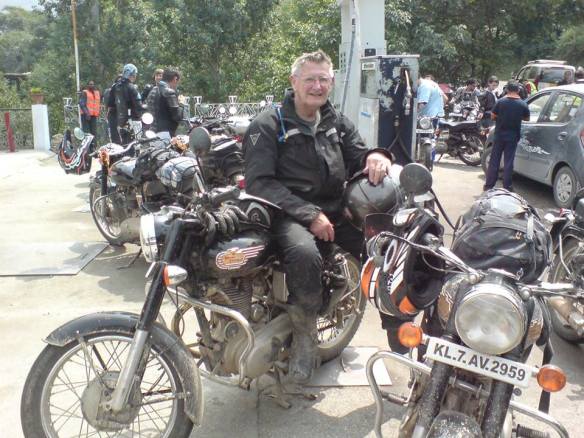
Dad was a citizen of the world. He spent his life travelling, firstly in the Army, then through his work designing, selling and installing quarry and asphalt plant, and latterly as a motorcycling adventurer. We lost count of the number of countries he had visited in his lifetime, and his Facebook page includes contacts from across the globe. We’ve been overwhelmed by the many tributes and anecdotes from his friends, many of whom experienced his enthusiasm, inspiration and spirit of adventure as he took part in numerous organised runs across India and the Himalaya by Enfield motorcycle, forming links with an amazing group of people who obviously held him in high regard. My own experiences travelling with him to Germany are the subject of a previous blog.

Dad was a modest man but he was secretly proud to be showing the younger guys how it should be done, especially when many of those younger guys were well into retirement themselves. To be riding the highest roads in the world across rough terrain, rockfalls and heavy fords was a great achievement in itself, to be doing it in your mid-80s is pretty special.

I learned a lot from my father over his lifetime, and I’ll pick up on some of the key things in a future post. For now, it’s enough to record that he is no longer with us and that our family is in mourning. His funeral is on Tuesday 14th February in Loughborough, and there’s a lot to do before then to make sure we give him a great send-off.

Why This Rebel Is Keen To Remain In Europe

I’m on a narrowboat this week and not paying much attention to the news, but when an MP is murdered in cold blood it’s an event that can’t be ignored.

It seems as though the perpetrator was suffering his own mental health problems, but such extreme action has to have some underlying trigger. It wouldn’t be unreasonable to guess that the Brexit campaign could have been it. I can’t be the only one to have become thoroughly disenchanted with the way in which the campaigns have descended from at least some semblance of intelligent debate to bickering, personal attacks and name calling. It seems that this has to be the way of modern politics.

(FILES) This file photo taken on August

image from metro.co.uk

What depresses me further is that the debate seems to have become about nationalism and whether you are ‘for’ or ‘against’ Britain and her continued existence. To even suggest that a vote to Remain is anti-British has to be the ultimate in distortion of reality.

I’m as passionate about this country – by which I mean the United Kingdom in its entirety – as anyone, and it’s because of this very belief that I am so strongly in favour of staying in.

That doesn’t mean I’m happy with the status quo, far from it. Europe is by no means perfect, and if it is to succeed in the long term it has to change. I think that the idea of ever closer political union in Europe is wrong, and that the EU has made some significant errors of economic policy that haven’t helped the lives of its citizens.

Red Tape Can Be Good

But despite the rhetoric there is a lot of good to being a member of the European ‘Club’. A lot of the so-called ‘red tape’ that comes out of Brussels is aimed at harmonising trade, and that requires regulations to be proposed, drafted, debated and accepted. In return our businesses can sell their goods right across Europe with no further restrictions, and this has been a boost to trade over the years. In my own field, financial services, it has taken a long time to get this harmonisation in place and there is still a way to go, but Britain has been a significant winner in its areas of expertise, with 30% of the European banking market, half of Europe’s fund management business, and well over 80% of hedge fund activity, a major money-spinner for the City. Leaving the EU would definitely put this major trade at risk, and it could take years to recover our position. Surely if rules are being drafted for the pan-European market that we will have to conform to anyway, it makes sense to have a place at the negotiating table?

Immigration

Arrivals from the European Union customs channel at Stansted Airport, England, Britain UK

image from viewsbank.com

Perhaps the greatest area of concern for many people is that of immigration. On this one I’m probably of a different view to many, because I’m all in favour of open borders. In my idealistic world it would be possible for anyone to travel anywhere without hindrance, and it would be great to think that, one day in the future that might happen. I do accept that the world isn’t ideal, of course, and in reality controls are required, but free movement of goods, services and people within the EU seems to me to be a laudable objective. This doesn’t mean free access to all services the state provides, of course, and it’s here that the debate should focus in my view. David Cameron has already gained acknowledgement of this within Europe and the Government’s policy has for some time been aimed at limiting benefits for migrants.

There’s a well-proven economic case for such free movement. At a time when Western economies are facing the prospect of ageing populations as the 1950’s baby boomers’ move into retirement, we need younger workers to be able to grow. It’s also true that many new businesses are started by immigrants seeking a better life for their families. Ultimately the way to resolve the pressure of immigration is to help make the countries from which the people come to be stable and prosperous, and here the EU has a role.

If we were to exit the Union I really can’t see how things would change much on this front, either. A large proportion of immigrants are from non-EU countries already, and we couldn’t hope for much tighter controls whilst enjoying unfettered movement of our own goods, services and citizens. It’s folly to believe otherwise.

Change is already happening

There is evidence that the EU is already changing. Its politicians are getting the message that, right across Europe, there is disenchantment with its opaqueness and remoteness from the people whose lives it affects. The influx of smaller nations who have joined in recent years

Eu Flags

image from guardian.co.uk

aren’t interested in ever closer political union, they want better access to Europe’s markets, stability, and protection against aggressors, notably Russia. Britain, with its emphasis on defence (on which we spend more than most other Euro nations) and trade is seen as a strong and consistent voice with the scale and economic clout to be a positive leader in Europe. The very intensity of the UK Brexit debate has made politicians across Europe sit up and take notice. We aren’t the only ones who aren’t entirely happy, as evidenced by rising nationalistic voices in France, Germany, Spain, Italy and many other countries. Something must be done.

Agitate from within

I’ve always seen myself as something of a rebel. I’m all in favour of shaking things up and agitating for change. But I came to realise a long time ago that crusading through the streets holding placards and chanting slogans is nothing like as effective as being on the inside and influencing things with the people who hold the power. Attractive as it might feel to make a protest against Europe and ‘stand up for Britain,’ let’s not throw away years of negotiations and effort that could set us back 10 years or more and leave us with less influence and no real gains.

Instead, let’s create the necessary change from within with a strong voice and firm principles. Let’s stand up for Britain as a negotiating partner and not a truculent absentee.

In my humble opinion, a vote for Britain is a vote to Remain.

Andy Jervis

19-06-2016

Reflections on Hong Kong from Five Miles Up

I don’t much like long haul flights. The seats aren’t built for sleep, there is too much noise, the entertainment screen – good as it is on Virgin planes – is too close to my face, and you never quite know what time it is. The food, whilst palatable, sits on one’s stomach and disrupts the body clock. And if the flight doesn’t get to you, the waiting around for hours in airport queues probably will.

Is it worth all of this disruption to one’s bodily routines?

If there was another way to travel the world that overcame these drawbacks, I’d do it. Until that happens (I’m  thinking Star Trek transporter system) we’ll just have to make do.

Because the pain is definitely worth it. Our trip to Hong Kong has been something else.

As I reflect back on the last few days, I realise that our initial apprehension as we first experienced the city’s frenetic lifestyle and energy, its multiculturalism and its diversity, has turned into admiration for a new-found friend. Hong Kong grows on you.

It’s a city in which you soon begin to feel at home. The people  are unfailingly polite and helpful, such as when an elderly gentleman stopped to help us work the ticket machine on the  MTR underground platform in the middle of rush hour, or when the lady on duty at Nan Lian Gardens welcomed us to the park, told us about the layout, and made us feel special.

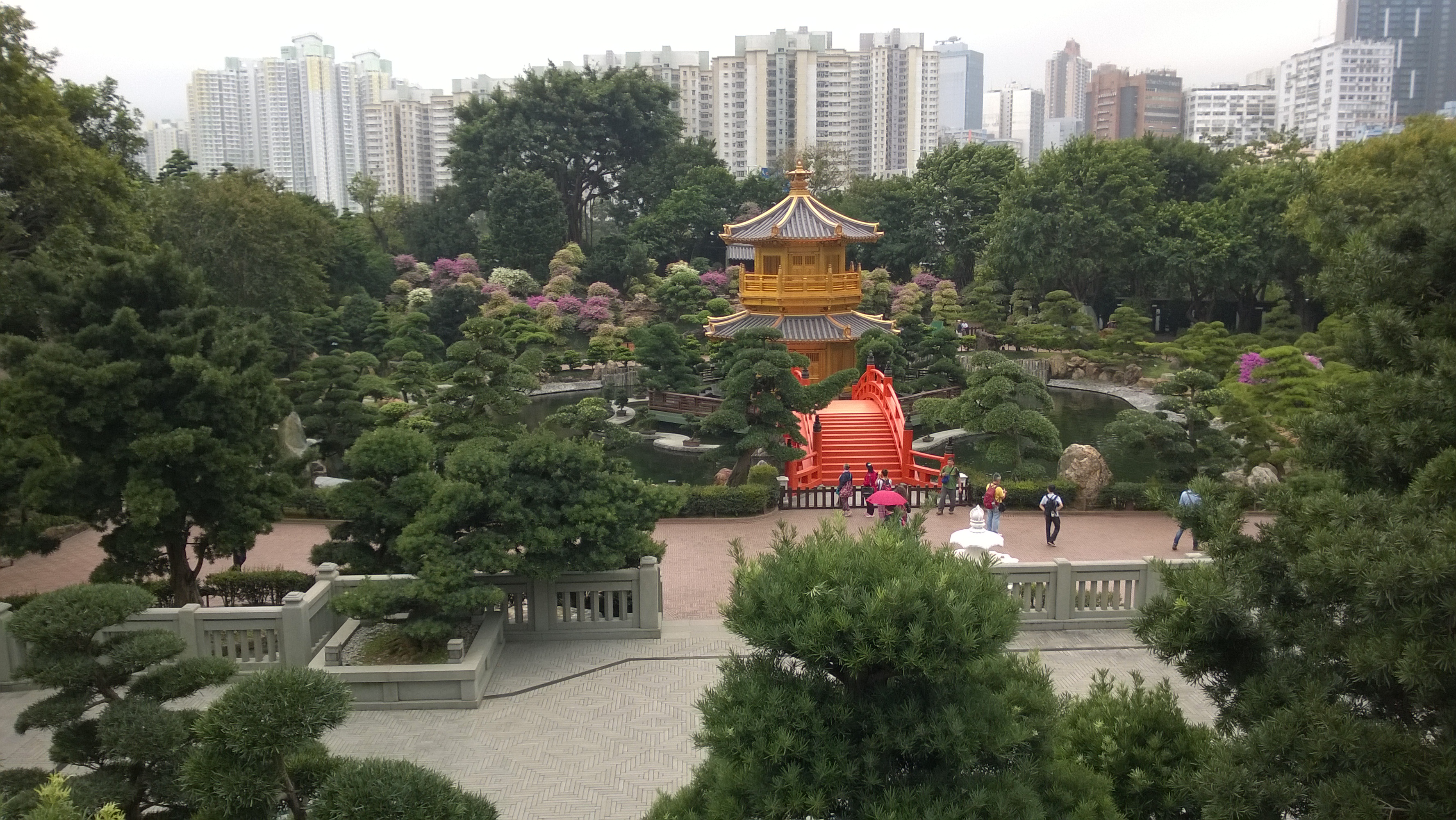
Our visit to the Gardens was earlier today (or was it yesterday? I’m writing this in mid-air). Sitting a little way out of the city centre right next to the Diamond Hill MTR station, itself underneath the Hollywood Plaza shopping centre, the Gardens are superb. Relatively recent, they are laid out in 1,200 year-old Tang Dynasty style with typical Chinese flair. A line of Banyan trees, with their amazing exposed root systems, leads to quiet pathways, delightful greenery and typically Chinese buildings constructed of beautiful redwood, including a gold pagoda at the centre, striking against the backdrop of residential towers that frame it in the distance.

Nan Lian Gardens

Nan Lian Gardens

Above the Gardens lies the Chi Lin Nunnery, a Buddhist temple set out around a wide ornate courtyard. There is a service taking place and the sounds of passages being read out to the accompaniment of Buddhist bells mixes with the scent of incense.

And yet, only yards away, busy flyovers carry traffic through the city, whilst every view contains an image of the ever-present skyscrapers towering over the scene. It’s another example of the conjunction of old and new, East and West, that makes Hong Kong so fascinating. It’s claim to be ‘Asia’s World City’ seems fully justified to this not-so-seasoned traveller.

The Chinese are obviously pleased to have got their city back. The reunification was 18 years ago, and the agreement signed by Mrs Thatcher at that time stipulated that the new ‘SAR’ – Special Administrative Region – would remain unaltered, with its own separate legal systems and democratic processes, for at least another 50 years. That doesn’t seem so long now we’re a third of the way through it.

Earlier we had visited the Hong Kong History Museum on Chatham Road South. Through a series of large halls the story of the area is told, from the formation of the rocks on which the city is built (mostly volcanic granite) to the earliest tribes, the rise of agriculture and Chinese traditions, cultures and beliefs, through to the Opium Wars, the Cessation of Hong Kong, the creation of the banking systems (especially the good old Hong Kong & Shanghai Banking Corporation, whose Head Office stands proudly overlooking the Harbour, and which is responsible for printing and supervising the local currency, the HK Dollar), the Japanese occupation during WW2, and finally to the handover in 1997. It’s all handled in an open and informative way, with apparent balance. That is, until the final audiovisual presentation which sums up in a few minutes the story of the SAR. The emphasis is heavily on the return of the Region to the fold, with the Brits cast as the interlopers and no recognition of the obvious benefits they’ve brought over the course of their 150 year tenureship.

Local elections are in train during our visit, with lots of posters showing headshots of the local candidates. Yet this week an item appears on BBC News reporting that the owner and three staff of a bookshop In Causeway Bay have mysteriously disappeared simultaneously. The shop was known for publishing texts critical of the Chinese Government and its leaders, and was popular with visitors from the mainland where those same books are banned from sale.

China has itself changed significantly in recent years, but by Western standards it has a long way to go in areas of free speech and personal liberty. Let’s hope that Hong Kong can remain the truly international jewel that we have so enjoyed during this last two weeks for many years to come. It’s been a great trip.

Breaking The Dragon’s Back

It’s oppressively hot, the humidity making us feel even warmer as well as perpetually damp as we fail to evaporate our sweat. The trail is well-used and clearly defined but quite demanding as we pick our way across rocks and boulders. As we face a 45 degree climb up the next rise we stop to catch our breath in the heavy air.

We’re on the Dragon’s Back, one of Hong Kong’s most famous trails. It’s popular on a Saturday afternoon, with plenty of locals as well as tourists taking the hike with us, some dressed in serious hiking gear and others in shorts and flip-flops. We’re pleased we’ve donned our walking shoes though.

It seemed an arduous journey to get here. Instead of opting for the highly efficient MTR underground service to the far end of Hong Kong, we decided on the scenic route of Star Ferry across the harbour, then the ancient but busy tramline all the way to its terminus at Shau Kei Wan. You board the trams at the rear and pay on exit, and at busy times (i.e., always) you’ll have to stand as people get off at each stop, gradually moving through the vehicle. Our persistence pays off as we eventually find seats at the back of the upper deck, with great views of the street scene. As everywhere on the island, high tech business towers mix with densely packed residential blocks, the latter displaying drying laundry at every other balcony. A walk along the street here seems as likely to result in being rained on by other people’s underwear as by the regular precipitation, although both have held off for us up to now.

We’re already feeling stiff as we emerge from the tram, it’s a rickety ride and the seats are hard. We walk around the block and eventually ask a minibus driver where we can find the number 9 bus. He guides us to the next street, where we find the bus station and a long queue already formed for our bus to Shek O, Hong Kong’s beachside ‘resort’. We climb aboard and look out for our stop as detailed in our Pocket Rough Guide (very helpful and highly recommended). Most buses have a display board showing progress, but this one was obviously broken so I ask the young man sitting next to me if we’re at the Dragon’s Back stop as he and his party get up to leave. ‘Yes, yes, this is it’ he tells us, and indeed when we alight we find a wooden sign pointing to the Dragon’s Back trail. Something doesn’t feel right, though, so we study the helpful maps displayed on boards a few yards up the path. After working out that this map shows South at the top (not always obvious) we realise that we’re at the wrong end of the trail. The intended route would have involved turning right at the ‘end’ and walking down to Big Wave Bay for a welcome drink, but going this way means we’ll either have to retrace our steps or catch the bus back at the other end.

So we return to the road and wait for the next No 9 to arrive. Fortunately they are every few minutes, so before long we’re at the ‘proper’ end of the trail and making our way up through the undergrowth.

As we get higher the views become more rewarding. There’s a lot of cloud about today and it’s nowhere near as warm as it could be – we wouldn’t fancy doing this walk in midsummer – and the top of Victoria Peak in the near distance is intermittently shrouded in cloud. Further away to the west are the islands of Lamma and Lantau, whilst as we get even higher the east coast comes into the picture too. At one point we reach the top of a rise to find a panoramic view of Shek O, with its beach, golf course, and executive homes directly below. It’s a great sight.

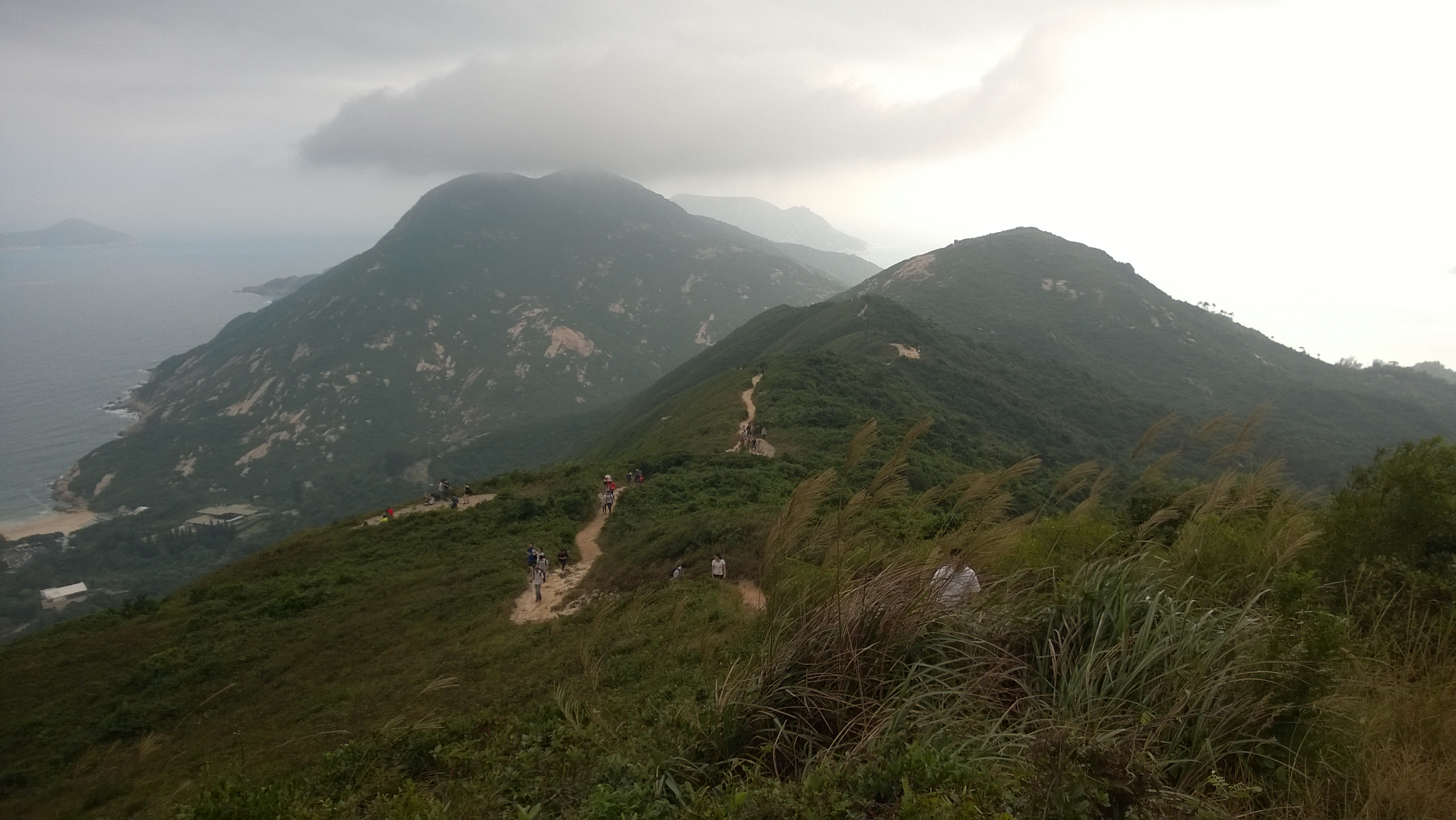
We understand how the Dragon’s Back got its name as the trail is displayed before us, rising and falling over successive peaks like travelling along the spine of a huge reptile. We stop to enjoy our sandwiches on a bench looking out to sea. As we do so a hang glider soars past for the third time, its pilot obviously highly skilled in riding the updrafts as he serenely criss-crosses only a few yards away.

Walking the Spine of the Dragon

Walking the Spine of the Dragon

Eventually the trail drops down onto the steep slopes of the hillside, it’s well-trodden route offering lots of opportunities for twisted ankles. It doesn’t slow down several runners, though, obviously much fitter and braver than us.

Finally we get back to our ‘starting’ point, and turn right under the trees heading for the beach. Our legs are getting tired now and the light is starting to fail. The concrete road is level for a good way offering easy walking, but halfway along the trail suddenly turns at right angles down a steep path, regular steps cut into the stone. It’s hard work going constantly downwards, jarring bones on some of the deeper drops.

The town still looks a good distance away, but suddenly we’re there, emerging alongside homes and next to a children’s playground. We buy cold Coke from the stall by the beach and guzzle it down, grateful for the refreshment after our exertions.

Big Wave Bay is lovely, with golden sand leading out to the sea. It’s obviously a mecca for surfers, and there are many of them out among the waves. It’s getting late in the day but this place is worth another visit.

After a few minutes enjoying the view we catch the minibus that’s just leaving the car park, which drops us right next to Shau Kei Wan MTR station. This time we opt for the quick way home.

Except we don’t stop at Tsim Sha Tsui and our hotel, but carry on to Yau Ma Tei, two stops further on up Nathan Road and next to the Temple Street Night Market. We’ve got some bargaining to do, but that’s a story for another time.

People, People Everywhere…..

One of the characteristics of Hong Kong that most people have mentioned is that it’s full of people. As one of the most densely populated places in the world, that’s certainly true.

Walking down busy Nathan Road, adjacent to our hotel, we’re constantly changing direction, stopping and sidestepping as one does on busy streets. I’m reminded of one of James Herriot’s stories where farmer Arnold Summergill describes one of his rare visits to the local town and why he couldn’t walk on the street. There were too many people about, he said, and he’d had to take ‘big steps and little ‘uns’ and couldn’t get going. ‘Big steps and little ‘uns’ well describes progress here.

It gets far worse, though. We took the MTR underground train last night during rush hour, feeling like fish in a massive moving shoal as we swept with the tide towards our destination. Getting on the wrong side of the people stream can be risky, because having to cross to regain your direction of travel requires bravery and focus. Once across, though, you go with the flow once again until the next change of direction. Just have your ticket ready for the exit barriers.

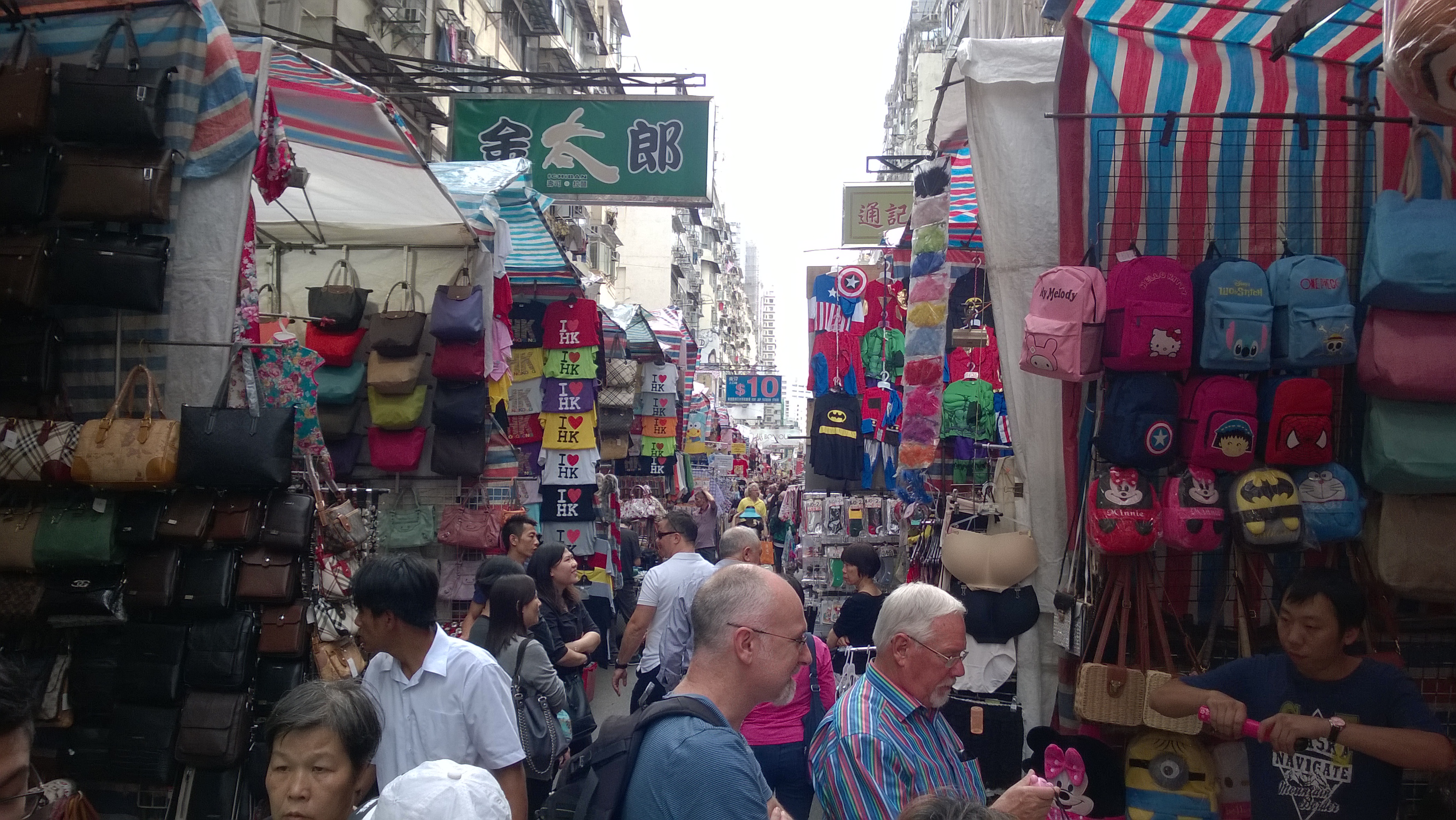
And then there’s a different kind of crowd as we meander through the Ladies Market. This kilometre-long row of stalls is jammed into the street, with narrow walkways through which we thread carefully. It’s effectively a six-lane market, with two sides to each row of stalls plus the adjacent shops on either side, many of them open-fronted. Here you can buy formal wear, casual wear, outerwear, underwear, rainwear, footwear and sportswear, and a massive range of goods, bags, trinkets, beauty products,,, the list goes on.

Hong Kong Ladies Market

Ladies Market

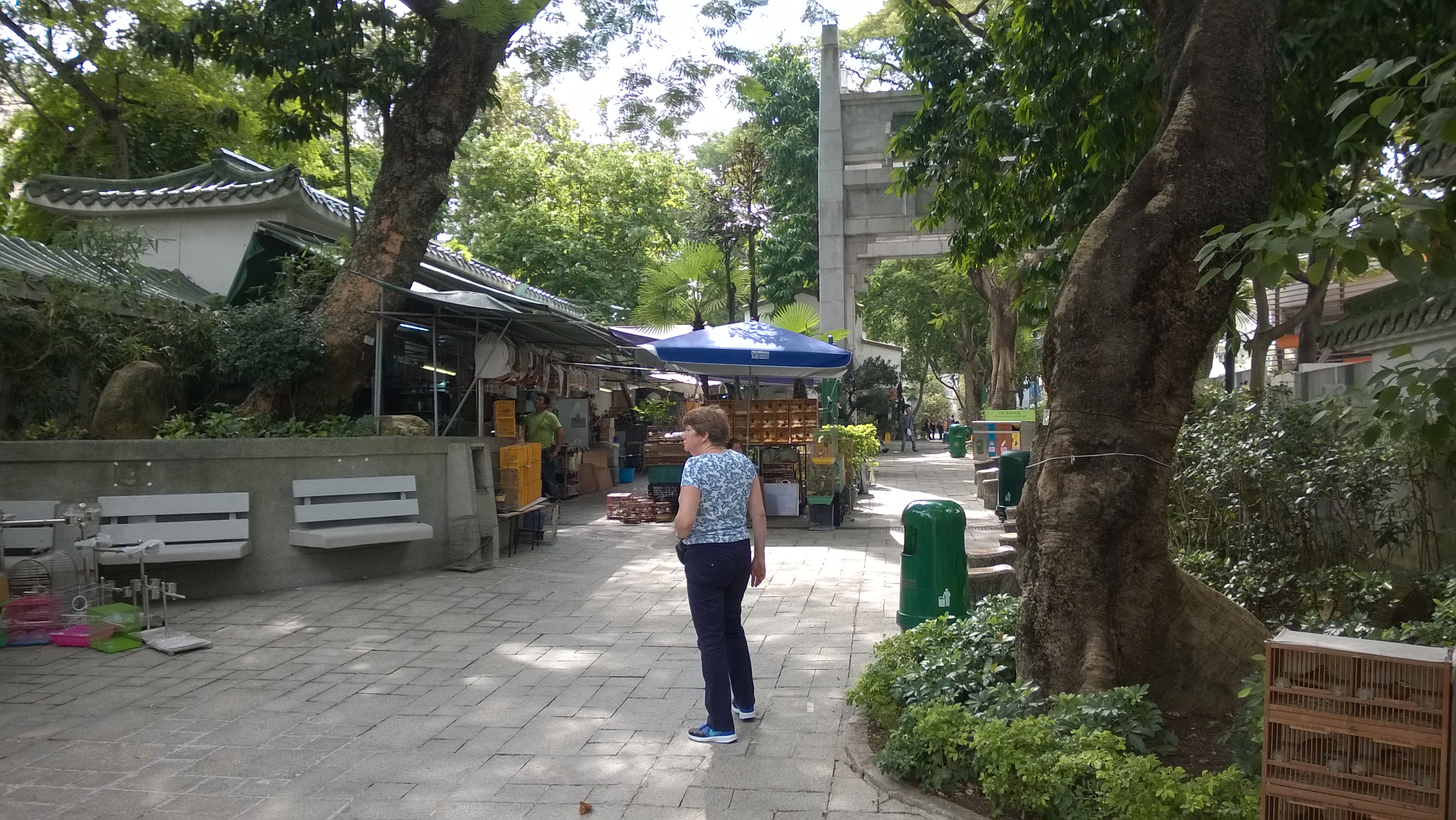
It’s been markets day today. We started at the Flower Market, a street full of cut flowers, garden products, and shrubs, offering a colourful spectacle and delightful scents. At the end of Flower Market Street is the Bird Market, an area full of semi-permanent stalls selling a vast array of cage birds, from parrots to finches and everything in between, as well as all of the paraphernalia you need to keep your bird, including cages and stands, trinkets and food.

In the latter category it’s possible to buy not only bags of assorted seeds, but also live bird food in the form of bags of crickets and beetles. Apparently the crickets are fed to the hungry bird using chopsticks, an implement we haven’t yet mastered. Perhaps we ought to practice a bit more if we’re to avoid a nasty accident with the cricket supply.

But Hong Kong isn’t all surging crowds. Like all great cities, there are many small oases of calm dotted around. Street gardens and parks offer shaded sitting areas, many of them in delightful surroundings. The Bird Market itself is an unflustered area of calm despite the accompanying trill of thousands of tiny finches. On our return journey we stop in at the Tin Hau Temple, it’s interior a place for quiet reflection like any religious house. Here, it’s the nose and eyes that are assaulted by the constant burning of incense, obviously an important part of the ritual of worship.

Hong Kong Bird Market

Bird Market

We eventually retreat to our hotel to spend some time by the pool. Nine floors up, we’re untroubled by the hustle and bustle below. The peace and quiet is welcome.

View From The Peak

Sitting in Bubba Gump Shrimp Co, the restaurant themed around Tom Hanks’ famous film character Forrest Gump, being served by Chinese staff whilst watching the Darts Championship on the TV, is a reminder of the multicultural nature of this great city. I may be wrong, but I’m not sure that the staff really appreciated the significance of each diner’s table top sign instructing them to ‘Run Forrest, Run’ or ‘Stop Forrest, Stop’ when service was required, even with the film constantly repeating itself on a monitor on the wall. Highly attentive service is a feature, we had discovered, of this part of the world and the signs almost seemed to get in the way of that.

To recap, we’re in the Sky Terrace 428, a shopping mall near the top of Victoria Peak, 428 metres above sea level in Hong Kong. Above us is the viewing platform that any tourist worthy of the name has to visit, including us. Below, shimmering in the darkness like a massive fairground, are the skyscrapers of Hong Kong, Kowloon and beyond, a superb accompaniment to our chosen dish of multiple types of shrimp in batter.

Getting up here is either a demanding climb up the hillside in the clinging humidity, or the easy option of the famous Peak Tram. This ancient funicular railway, the first ever built in Asia during the reign of Queen Victoria after whom the area draws its name,  charges up the hillside at an oblique angle, rising over 1,300 feet in less than a mile and around 8 minutes. We choose the easy option. The orientation of the seats makes it seem that the adjacent towers are leaning heavily to one side as you ascend, a weird feeling. It’s a popular trip, and the carriages are packed with people both ways.

The views from the Sky Terrace are well worth it, though. From Happy Valley, just out of sight to the east, to the islands lying to the west, it’s a fabulous panorama of high rise towers, boats, sea and mountains. It’s one of those views you have to experience to appreciate.

We’d travelled up in daytime, but night falls quickly here and before you know it, it’s dark. The city transforms below you as the lights flicker on, and I reckon the guidebook is right when it says that this is a view you never tire of, because it’s constantly changing.

We were thinking of walking back down through the forest, but we change our minds in the dark and ride the tram back to Central. From there it’s a short walk to the financial centre, with it’s massive buildings and harbour-facing illuminations jockeying to show how rich, powerful and important are the owning institutions. Pride of place has to go to HSBC’s massive block, looking like a giant elongated toaster. Apparently having an unrestricted view of the water the building has great ‘feng shui’, an important consideration in HK, which guarantees it future prosperity. So if you want to bring down the bank, you just need to build something else in front of it. You might have trouble with planning permission, though.

We’re soon back to sea level on the famous Star Ferry for it’s short but dramatic trip across the Harbour to our hotel in Tsim Sha Tsui after a great introduction to the city.